Irrigation Makes It Rain? Climate Spillovers and Adaptation in India
Job Market Paper (draft available soon)
Can economic development change the climate and reshape its own trajectory? I study how large-scale irrigation infrastructure modifies weather patterns and agricultural development in India. Combining five decades of administrative, climatic, and agricultural data, I exploit wind direction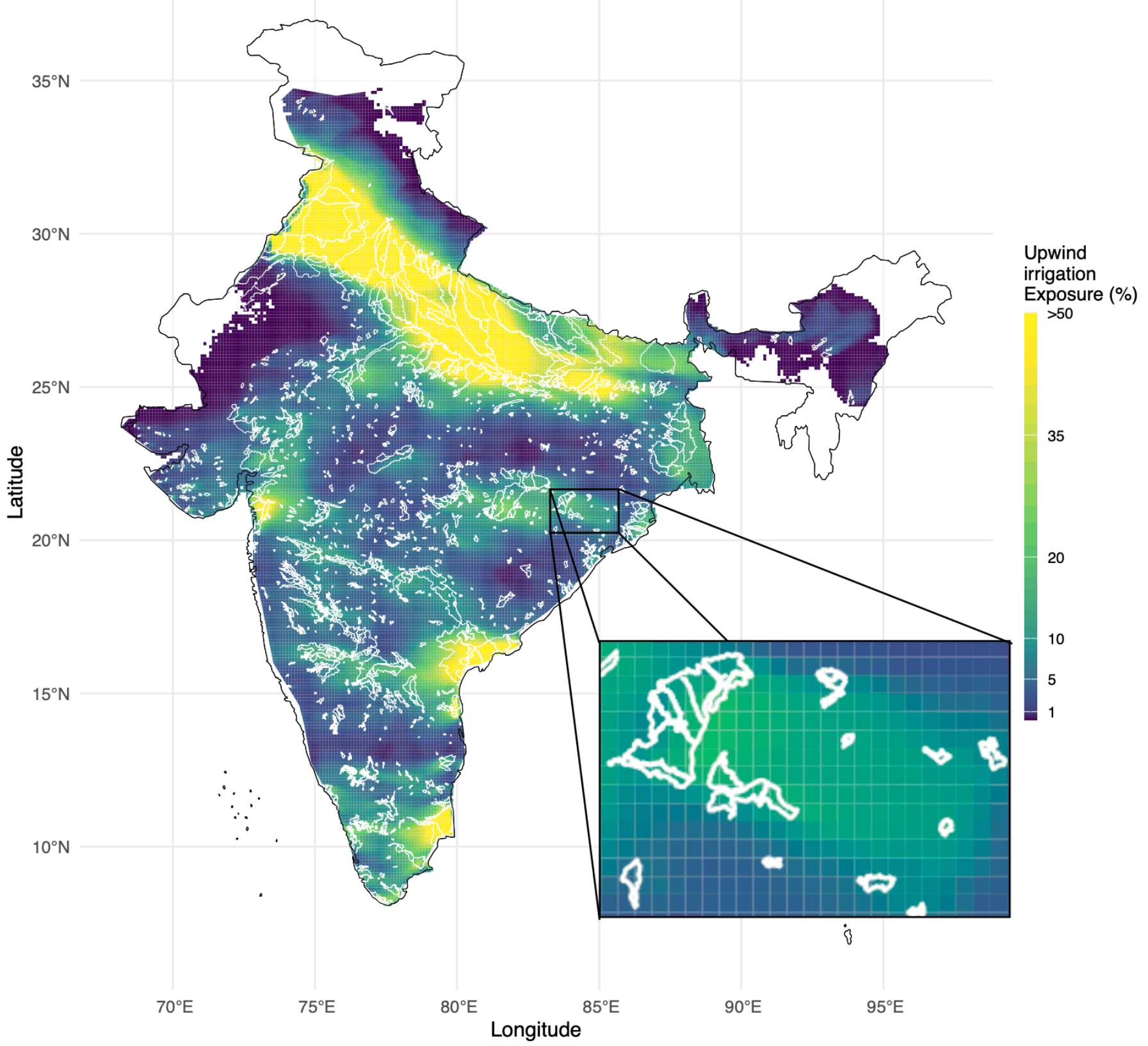 as a source of exogenous exposure to distant irrigation schemes. A 10 p.p. increase in irrigation, about half of India's Green Revolution expansion, raises dry-season rainfall by 5 mm per month and lowers temperatures by 0.4°C. Effects reverse during the monsoon, with declining rainfall and seven additional days of crop-damaging heat.
Crop production rises by 5% in the dry season without yield gains, whereas wet-season crop yield increases slightly by 1.3%. The evidence points to adaptation rather than a direct climate-productivity effect alone. Farmers expand private irrigation downwind, which enables double cropping on more marginal land during the dry season and offsets wet-season losses. In the long run, these spillovers sustain smallholders while enabling larger farms to expand, polarizing the agricultural sector. Overall, this climate externality accounts for 7% of crop production growth during the period, worth an extra $1 billion a year.
as a source of exogenous exposure to distant irrigation schemes. A 10 p.p. increase in irrigation, about half of India's Green Revolution expansion, raises dry-season rainfall by 5 mm per month and lowers temperatures by 0.4°C. Effects reverse during the monsoon, with declining rainfall and seven additional days of crop-damaging heat.
Crop production rises by 5% in the dry season without yield gains, whereas wet-season crop yield increases slightly by 1.3%. The evidence points to adaptation rather than a direct climate-productivity effect alone. Farmers expand private irrigation downwind, which enables double cropping on more marginal land during the dry season and offsets wet-season losses. In the long run, these spillovers sustain smallholders while enabling larger farms to expand, polarizing the agricultural sector. Overall, this climate externality accounts for 7% of crop production growth during the period, worth an extra $1 billion a year.